Golden Casino History: 1997 Origins, WGS Software and Brand-Identity Questions
 Available in AU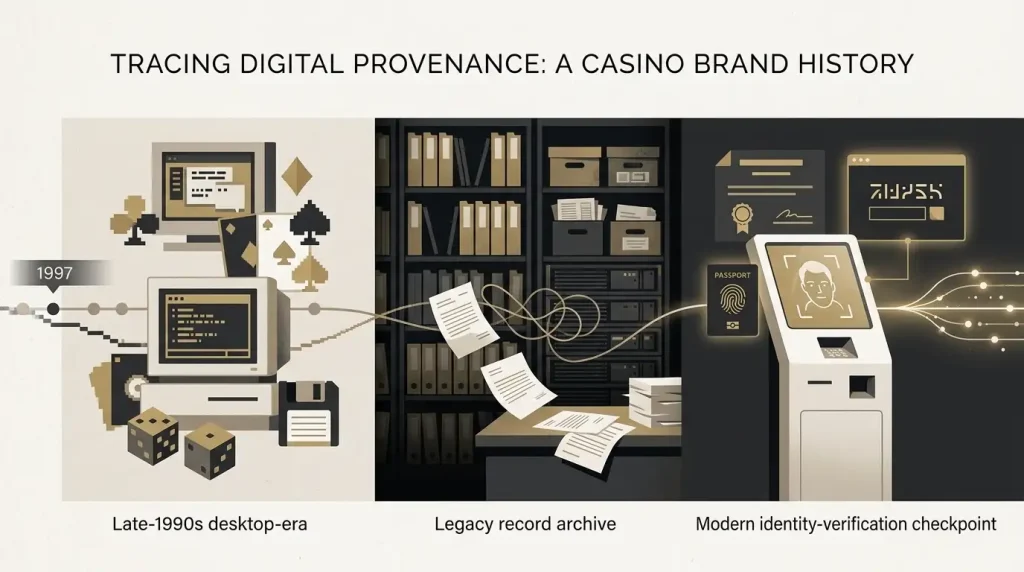
Table of Contents
- The verified historical record starts in 1997
- Why the closure evidence changes how current claims should be handled
- WGS Technology is useful evidence, but only for the legacy casino
- A same-name app demonstrates the identity problem
- What a proper brand-instance match should contain
- Historical Curaçao references and current Australian licensing are separate records
- A practical provenance checklist for Golden Casino
- Golden Casino history FAQ
- Why dates and identity fields belong together
- Why Golden Casino's 1997 record matters when checking the brand in 2026
Section element
Brand provenance
Independent historical profiles trace Golden Casino to 1997 and associate the legacy casino with WGS Technology, also known as Vegas Technology, English-language service, US-dollar play and Curaçao. Current third-party records checked in September 2026 describe that historical casino as closed. That creates an important identity problem for anyone researching a modern product called Golden Casino: a matching name alone provides too little evidence to connect a current website or app to the same operator, legal entity or gambling service. The safest way to read the record is to separate what is verified about the legacy brand from what still needs fresh operator, domain and licence evidence.
The verified historical record starts in 1997
Two independent casino-information sources place Golden Casino’s establishment in 1997. That date is the strongest anchor in the legacy record because it appears consistently across historical profiles rather than being inferred from a modern domain or app listing. The same source set links the casino to WGS Technology, also referred to as Vegas Technology, which gives the old brand a recognisable software profile.
Historical profiles also list English as the operating language and USD as the casino currency. Those details matter for people in Australia because they are historical descriptors; 2026 AUD support, Australian payment rails and current Australian access require current evidence. A dated profile can tell us what the legacy casino looked like, but it cannot automatically establish the configuration of a present-day service.
The historical material also associates Golden Casino with Curaçao. That attribution should remain historical unless a current regulator record, current operator disclosure or other qualifying source proves a present licence. A jurisdiction mentioned in an old casino profile applies to that historical record and requires a fresh connection before it can be associated with a later same-name product.
Why the closure evidence changes how current claims should be handled
Current third-party pages add a second layer to the history. AskGamblers includes Golden Casino in its closed-casino directory, while Casino Listings describes the legacy casino as closed for business. Those are current signals about the legacy property represented in their databases. Their scope stays with the legacy listing because unrelated developers or operators can reuse the same name.
The practical conclusion is narrower: carrying the historical identity forward requires a verified bridge. A bridge would be evidence such as a current official domain linking back to the historical operator, a regulator record naming the same legal entity, an operator statement documenting a revival, or another strong source connecting the old brand to a current service. Absent that link, a review that copies legacy facts into a modern profile risks combining two different businesses.
This is especially important when search results mix old review pages with current app listings. Search engines rank pages by relevance to words rather than by proof that every result belongs to one corporate identity. Brand provenance therefore has to be established separately from name similarity.
WGS Technology is useful evidence, but only for the legacy casino
WGS Technology, also identified in historical material as Vegas Technology, is one of the clearest fingerprints of the old Golden Casino. When two independent sources attach the same software supplier to the same brand, the detail helps define the historical product more precisely than the brand name alone.
A modern Golden Casino requires its own evidence before the old WGS association can be carried forward. Current games, language, currency and licensing all need fresh evidence tied to the current brand instance.
Anyone interested in the broader software record can use the Golden Casino trust to see how source quality and licence evidence are separated from historical review data.
A same-name app demonstrates the identity problem
The Australian App Store currently lists a product called “Golden Casino – Slots Games” from developer Slots Limited. The listing describes it as a free casino-style slots game and explicitly limits it to play-for-fun use with real-money winnings excluded. That makes it a useful example of why a shared product name cannot establish operator identity.
Nothing in the App Store listing, by itself, connects Slots Limited to the historical WGS-powered real-money casino. The developer name differs from the operator names found in old casino material, and the product category is different. Treating the app as a continuation of the 1997 casino solely because both contain the words “Golden Casino” would be a source-matching error.
The Golden Casino mobile uses this example in more detail and shows the fields that should be compared before an app is treated as an official companion product.
What a proper brand-instance match should contain
A reliable identity match uses several independent fields rather than one familiar label. For a casino brand, the strongest set normally combines operator or legal-entity name, official domain, licence or regulator record, product links and continuity over time. If those fields line up, a historical fact may have a defensible path into a current profile. When those fields diverge, the fact stays attached to the historical instance.
| Field | What to compare | Why it matters |
|---|---|---|
| Operator | Legal entity or named business behind the product | Names the organisation rather than just the storefront |
| Domain | Official website and linked subdomains | Helps distinguish unrelated sites using similar branding |
| Licence | Current regulator entry and licensed entity | Connects a gambling service to a jurisdiction and operator |
| Software | Current suppliers versus historical WGS record | Can support continuity as one part of a wider evidence chain |
| App developer | Store seller and developer identity | Separates a same-name app from a casino operator |
Continuity requires a connected chain of evidence across multiple fields rather than reliance on a familiar name.
Historical Curaçao references and current Australian licensing are separate records
Historical third-party profiles associate Golden Casino with Curaçao. That is useful provenance, while an Australian local licence and a current 2026 Curaçao licence number or status each require their own regulator evidence. Those are separate questions that require current regulator evidence.
For people in Australia, this distinction is particularly important because local regulatory status requires a current local source rather than inference from an offshore historical profile. The Golden Casino Australia review treats local licence checks and current brand identity as separate evidence tracks. A historical jurisdiction can explain where an old operator was associated, while a modern Australian claim needs a current Australian source.
A practical provenance checklist for Golden Casino
- Fix the date first. Mark 1997, WGS Technology, English, USD and Curaçao as legacy-profile facts.
- Check current status separately. Current review directories describing the old property as closed provide evidence about the historical listing only; each same-name product requires its own identity check.
- Require an identity bridge. Look for operator, domain, licence and official-link continuity before merging old and new records.
- Keep app evidence in its own category. A store listing proves that an app exists and identifies its developer; casino ownership requires an additional operator connection.
- Verify licences afresh. A historical Curaçao association belongs to the legacy record, while current foreign or Australian licensing requires current regulator evidence.
- Recheck current product features. Mobile support, games, payments and account terms need contemporary evidence rather than historical carry-over.
Golden Casino history FAQ
When was the historical Golden Casino established?
Independent historical profiles place its establishment in 1997.
Which software was associated with Golden Casino?
Historical profiles identify WGS Technology, also known as Vegas Technology, as the casino’s game supplier.
Is the old Golden Casino still operating?
Current third-party directories checked in September 2026 describe the legacy casino as closed. That finding applies to the legacy property, while the status and ownership of each modern same-name product require separate evidence.
Is the Slots Limited app the same casino?
The available evidence leaves that connection unresolved. The Australian App Store identifies Slots Limited as the developer and describes the product as a free, non-real-money slots game.
Why dates and identity fields belong together
A date gives historical evidence a clear boundary. The 1997 origin, WGS / Vegas Technology association, English language, USD currency and historical Curaçao reference form a legacy profile. Current identity requires a separate chain that connects operator, domain, licence information and product links. Using both date and identity together keeps the old record informative while preventing it from being assigned automatically to an unrelated modern product with the same name.
Why Golden Casino’s 1997 record matters when checking the brand in 2026
Golden Casino’s legacy record is useful precisely because it creates boundaries around what can be said with confidence. The 1997 start, WGS Technology association, English language, USD currency and historical Curaçao attribution form a coherent profile of the older casino, while current directories describe that legacy property as closed. A modern website or app should inherit none of those facts until operator, domain and licence evidence connects it to the same brand instance. For people in Australia, that provenance discipline prevents a familiar name from turning old facts into misleading current claims.